What a Million Hours of Home Care Taught Us About Aging Well
After many years and more than a million hours in people’s homes, the lessons that matter most are not the ones I expected.
By Kristiana Rajack , Manager of Care Operations, Assurance Home Care

When you deliver care one visit at a time, you learn things slowly. A single client teaches you about that client. A hundred teach you about a neighbourhood. It takes thousands of clients and something over a million hours before certain patterns become impossible to ignore, and several of them are not what I would have guessed when I began my career in home care.
Here is what a decade of showing up in people’s homes has actually taught us.
1. Consistency beats intensity, and families
If I could give a family only one thing, it would not be more hours. It would be the same person, every visit.
This is the single most common request we receive. When families describe what they want for a parent, the phrase that comes up more than any other is some version of: can it be the same caregiver each time. They ask for it before they ask about price, and long before they ask about credentials.
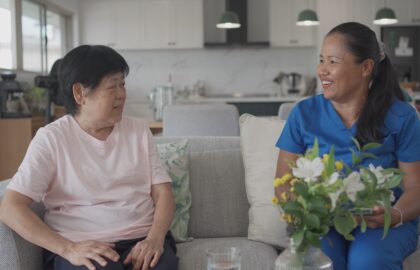
Their instinct is correct, and it turns out to be clinically important as well as emotionally important. A caregiver who returns week after week learns what normal looks like for that person. She knows he usually finishes his lunch and today he did not. She notices the walk to the kitchen taking longer than it did a fortnight ago. That is not something you can put in a care plan, and it is exactly how deterioration gets caught early.
caregiver who returns week after week learns what normal looks like for that person. That is how deterioration gets caught early.
Someone new, however well trained, is starting from zero every time. More hours from rotating staff is a worse product than fewer hours from a familiar face, and families work this out long before the industry admits it.
2. Care follows a predictable arc, so plan for the arc Most families come to us at a single point of need.
A hip replacement, a bad winter, a diagnosis. They are thinking about the next three months.
What our records show is that need rarely stays where it started. The most common path begins with something light, help around the house, a bit of company, a hand with the shopping, and gradually extends into personal care, then medication support, then in some cases overnight or live- in care. The arc is not universal and it is not always upward, but it is common enough to plan around.
The families who handle this best are the ones who chose a provider they could grow with, rather than the cheapest option for the immediate problem. When needs increase, and they usually do, the
alternative is introducing a stranger during a crisis, which is the worst possible moment to be building trust from scratch.
3. Winter is a mental health problem before it is a physical one
I used to describe winter as a period of higher demand.framing was lazy, and it misses what is actually happening.
The demand curve does rise, but not dramatically. What changes dramatically is what happens inside the home. Ice and snow make going out truly dangerous for someone unsteady, so they stop going out. The walk to the shop stops. The church group, the coffee with a neighbour, the small errands that structured the week all stop with it.
What follows is a quiet spiral that has very little to do with the weather. Mood drops. Someone who was social becomes withdrawn. Confusion that was manageable becomes more pronounced when there is less to anchor the day. Appetite falls off. And because they are moving less, strength and balance decline, which makes the next attempt to go out even riskier.
By March, we are frequently looking at a person who is materially less capable than they were in November, and none of it was caused by a fall or an illness. It was caused by four months of a shrinking world.
Once you see winter that way, the response changes. It is not about scheduling more hours in January. It is about protecting connection and routine through the months when both are under threat: keeping visits regular even when nothing is obviously wrong, getting people out on the days when conditions allow, and paying close attention to mood rather than only to mobility.
4. Nobody does this alone, including us
Roughly three-quarters of the people we care for also have a family member deeply involved in that care. The daughter who manages the medications. The son who calls every evening. The spouse quietly doing more than anyone realises.
That family caregiver is usually the person whose health I worry about most, and they are almost never the person being assessed.
This is why I have come to think of home care as a collaboration rather than a service. It only works when everyone is fully in it: the client, the family, and our own team, from the client care specialist through the nurses to the coordination team. Each of those parties holds information the others do not have. When they are working in concert toward the same goals, the care is good. When they are not, no amount of scheduling fixes it.
5. Perfection is elusive. Excellence is not.
This is the lesson I would most want a family to hear before they start, because it sets expectations honestly.
Over months and years of care, things will go wrong. A caregiver has a family emergency of her own. A client has a health crisis at 3am. Siblings disagree about what their mother needs. Someone is late. Somebody misreads a situation. Life happens, and it happens inside care as much as anywhere else.
For a long time I thought the goal was to drive the number of those events to zero. It is not, because it cannot be done. The real measure of a care provider is not how rarely something goes wrong. It is what happens in the hour after it does.
The real measure of a care provider is not how rarely something goes wrong. It is what happens in the hour after it does.
Is it noticed and raised, or quietly hidden? Is the family told straight away? Is it solved with the family rather than around them? And does anything actually change so it does not recur?
That is why our promise to clients is not that nothing will ever go wrong. It is our Make It Right Guarantee: when something does go wrong, we own it and we fix it. I would rather make that commitment and keep it than make a promise about perfection that no honest provider can keep.
What it all comes down to
A million hours has not taught me a clever technique. It has taught me that this work is relational at its core. We are building relationships with clients, with their families, and with our caregivers, and doing right by all three is the whole job.
It is a marathon rather than a sprint. The families who find it most rewarding, and the ones who get the best outcomes, are the ones who approach it that way: choosing a partner rather than purchasing a service, expecting a long road, and understanding that everyone involved is on the same side.
If your family is at the start of that road, we are always glad to talk about what it might look like. You can read more about how care is usually built up over time, whether or not you ever become a client.
Our Commitment to Excellence
Assurance Home Care is proudly members of or accredited by leading provincial and national home care associations, the Better Business Bureau, and ISO 9001 certified. Each emblem represents our unwavering dedication to quality, trust, and the highest standards of care.