Look After the Caregivers and Everything Else Follows
Our caregiver turnover sits in the single digits against an industry that routinely loses four in
ten. That one number explains almost everything about the care a family receives.
By Paige Morrison, Care Concierge, Assurance Home Care

If you want to know what a home care company will actually be like to deal with, do not ask about their services. Ask what percentage of their caregivers are still there a year from now.
It is the least glamorous question in the sector and it predicts more than any other. I want to explain why, and I want to be straight about what it costs to get the answer right.
The state of the workforce
Personal support work in Canada is difficult, essential and consistently undervalued. In Ontario, PSW pay generally runs somewhere between $17.60 and $28.00 an hour depending on the setting, and the setting matters enormously. Hospitals sit at the top. Unionised long-term care homes come next. Home care, where the work is arguably hardest because you are alone in someone’s house making judgment calls without a colleague down the corridor, tends to sit at the bottom.
In private home care specifically, the average is nearer $19 or $20 an hour. That is the reality of the market we recruit in.
On top of the pay, the structural conditions push people out. Hours are unpredictable. Shifts are fragmented across a city with unpaid travel between them. Part-time and casual arrangements are the norm rather than the exception, which makes it very hard to build a life around the work. It is not surprising that a large share of the workforce leaves within their first year.
What turnover does to a family
Turnover is usually discussed as an operational headache. For the family receiving care, it is something much more direct.
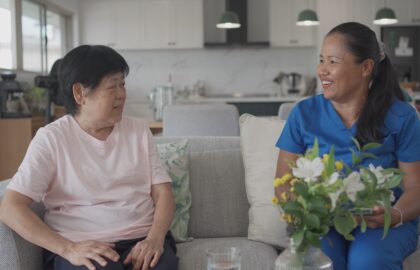
When a caregiver leaves, the knowledge leaves with her. The new person does not know that your father gets unsteady in the late afternoon, or that he will insist he has eaten when he has not, or that he responds better to being asked than told. She will learn it, and it will take her weeks. During those weeks, the early warning system that a familiar caregiver provides is simply switched off.
When a caregiver leaves, the knowledge leaves with her. Every departure resets the clock on a relationship, and the risk sits in the reset.
Multiply that across a year of high turnover and the family is never actually getting the service they were promised, no matter how good the promise was. Consistency cannot be delivered by a company that cannot keep its people.
Where we sit
Our annual caregiver turnover is in the single digits. Against a sector where losing four in ten within a year is unremarkable, that is the number I am proudest of, and it is not an accident or a lucky run.
It is also not primarily about money, which surprises people. We surveyed our caregivers anonymously, and the overwhelming majority told us they would stay with Assurance even if they were offered a ten percent raise to go elsewhere. I have thought about that result a great deal. A ten percent raise is not trivial to someone earning what caregivers earn. If they are turning it down, the thing keeping them is something that money at the margin does not buy.
What we think that something is
I am often quoted saying a version of this, so I will put it plainly here.
When you give caregivers agency over the kind of client they want to work with, give them the education, training and tools to deliver their very best, and support them with responsive and meaningful feedback, you end up with a team that is happy and feels a sense of fulfilment in what they are doing, knowing it makes a difference. That is what produces the best possible client experience.
Each part of that carries weight.
• Agency over their clients. Some caregivers are wonderful with advanced dementia and find palliative work very hard. Others are the opposite. Matching people to the work they are suited to and want is the single cheapest thing we do and one of the most effective.
• Education, training and tools. Nobody feels fulfilled doing a job they have not been equipped for. Investing in dementia training, safe transfers and recognising deterioration is partly a clinical decision and partly a retention one.
• Responsive, meaningful feedback. Home care is isolating work. A caregiver who raises a concern and hears nothing back concludes, correctly, that it did not matter. That conclusion is what precedes a resignation.
None of that is charity, and I would resist any suggestion that it is. It is the operating model. A caregiver who feels supported and well matched stays. Because she stays, she knows her client. Because she knows her client, she catches the decline early. Because the decline is caught early, the family avoids the crisis. That chain is the entire business.
The part that is hard
I do not want to present this as easily replicable. Paying above the market rate, offering predictable hours and full-time positions where we can, and funding real training all cost money, and that money comes out of the same hourly rate a family is comparing against a cheaper competitor.
That is the honest trade being made every time someone chooses a provider on price alone. The saving is real, and so is what was removed to create it.
What I would say to anyone weighing that decision is simply this: ask both providers what their turnover is. If one of them cannot tell you, or the number is close to the industry norm, you have learned something important about what the next year is going to look like.
Why this comes first
People sometimes expect the head of a care company to say that clients come first. I understand the sentiment, but I think it is the wrong way round, and saying so is not a slogan.
The client experience is produced almost entirely by one person: the caregiver standing in their living room. Everything else we do, the coordination, the nursing oversight, the technology, exists to support that moment. If the person in the living room is exhausted, poorly matched, undertrained or halfway out the door, nothing upstream of her can compensate.
Look after the caregivers properly and the rest of it follows. Get that backwards and no amount of anything else will save you.
If you are weighing up providers and want to talk through what to look for, we are glad to help. You can also read about the caregivers who deliver our personal support.
Our Commitment to Excellence
Assurance Home Care is proudly members of or accredited by leading provincial and national home care associations, the Better Business Bureau, and ISO 9001 certified. Each emblem represents our unwavering dedication to quality, trust, and the highest standards of care.