What Technology Should Actually Do in Home Care
The point of every tool we use is to give our caregivers back the time and attention that only
a human being can provide.
By Kristiana Rajack , Manager of Care Operations, Assurance Home Care

There’s a version of the conversation about artificial intelligence in senior care that I find genuinely useful, and we are already living in it. It starts from a simple premise: what can a machine do so that a human being does not have to, and what does that free the human being to do instead?
But much of the current conversation starts somewhere else. Technology is presented as a substitute for people, a sensor or an algorithm offered as the solution to a shortage of caregivers. The word innovation does a great deal of work to disguise the fact that nobody is actually being cared for.
The only test that matters
Every tool we have adopted has had to pass one question. Does this give our caregivers back time and attention, or does it take more of both?
A caregiver s hour is finite. If twenty minutes of it goes on writing a report, that is twenty minutes not spent with the person she is there to look after. Technology that reduces the twenty minutes is worth paying for. Technology that adds a second system to update, a new login, another form to complete at the end of a shift, is a cost dressed up as progress.
Does this give our caregivers back time and attention, or does it take more of both?
That test is deliberately unglamorous, and it rules out a great deal of what gets marketed to our sector.
What we are actually doing with it.
I want to be specific rather than aspirational, because a lot of companies in this industry talk about technology they have not implemented.
We use artificial intelligence and risk management within every one of our client care plans. Care documentation is analysed to surface changes that might otherwise go unnoticed across a stretch of visits. From that, daily registers are produced for our nurses to review and verify.
That last part is the part I would underline. The system does not decide anything. It raises a flag, and a nurse looks at it. A pattern that no single caregiver would necessarily catch, because each of them only sees their own visits, becomes visible to a clinician who can look across all of them at once and decide whether it means anything.
This has repeatedly done what it was designed to do. Early detection through these tools has prevented hospital readmissions and prevented new trips to hospital that would otherwise have happened.
Why avoiding hospital matters more than it sounds
When I say we prevented a hospital visit, it can sound like a modest administrative win. It is not.
A hospital is the correct place to be when someone needs a hospital. But for an older adult, admission carries its own risks. There is exposure to infections they did not arrive with. There is the disruption of routine, which is particularly hard on anyone with cognitive impairment. And there is deconditioning, which is the plain reality that lying in a bed for even a few days can take away strength and balance that took a long time to build and may never fully come back.
So a flag raised on a Tuesday that leads to a nurse visit on a Wednesday, instead of an ambulance on a Friday, is not a small saving. It can be the difference between someone continuing in their own home and someone beginning a decline that ends somewhere else entirely.
The tools that earn their place
Beyond our own care planning, the categories that have proven their worth and that have or will be implemented, share a common feature: they extend what a caregiver can observe, rather than trying to replace her judgment.
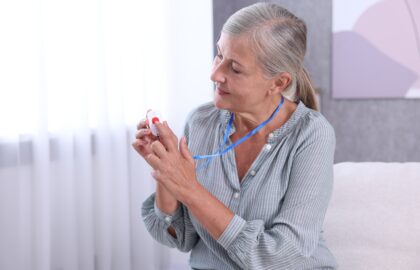
• Fall detection. Falls are the single most consequential event in most of our clients lives. Anything that shortens the time between a fall and a response is worth having.
• Medication reminders and dispensers. Missed or doubled doses are a common and preventable cause of deterioration. Automating the reminder removes a whole category of error.
• Remote monitoring of vital signs. Useful when clinically warranted, and unnecessary noise when it is not. The discipline is in deciding which clients actually benefit.
• Communication tools that keep families informed. The most underrated of the bunch. A family that hears about a change promptly does not have to spend the week wondering.
Adoption is not the barrier people assume. Older Canadians have taken up virtual healthcare in large numbers when it solved a real problem for them. They are not resistant to technology. They are resistant to technology that makes their life harder, which is a reasonable position at any age.
What no machine is going to do
Here is what I believe strongly. There is a category of work in home care that no system will ever perform, and pretending otherwise does the whole sector a disservice.
No algorithm will notice that a woman who always does the crossword has stopped doing the crossword, and understand what that means. No sensor will sit with a man on the anniversary of his wife s death. No dashboard will earn the trust of someone who has decided that accepting help means admitting defeat, and then gently change their mind over several weeks.
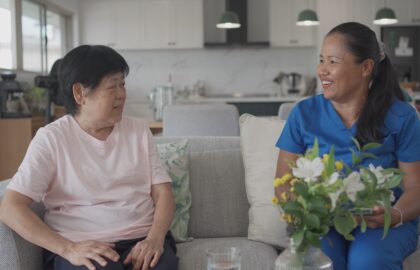
That work is emotional and relational, and it is the actual product. Everything technical we invest in exists to protect the conditions in which it can happen: to take the administration off a caregiver s plate, to catch the clinical risk she cannot see from a single visit, and to leave her free to do the thing she came into this profession to do.
The technology handles what is mechanical so that the people can handle what is human.
Most of our caregivers are in this work by vocation rather than by accident. They are good at something that is very difficult and largely unrecognised. The best thing our technology can do for them is get out of the way of it.
The honest position
I do not think artificial intelligence is going to solve the caregiver shortage, and I would be cautious of anyone who tells you it will. The shortage is a workforce problem and it needs workforce solutions.
What I do think is that a home care company that uses these tools well will catch problems earlier, keep more people out of hospital, and give its caregivers more of their time back than one that does not. We have seen all three. That is a meaningful advantage, and it is a very different claim from the one usually being made.
If you would like to understand how care is planned and monitored for someone in your family, our team is happy to walk you through it. You can also read more about the nursing oversight that sits behind our care.
Our Commitment to Excellence
Assurance Home Care is proudly members of or accredited by leading provincial and national home care associations, the Better Business Bureau, and ISO 9001 certified. Each emblem represents our unwavering dedication to quality, trust, and the highest standards of care.